
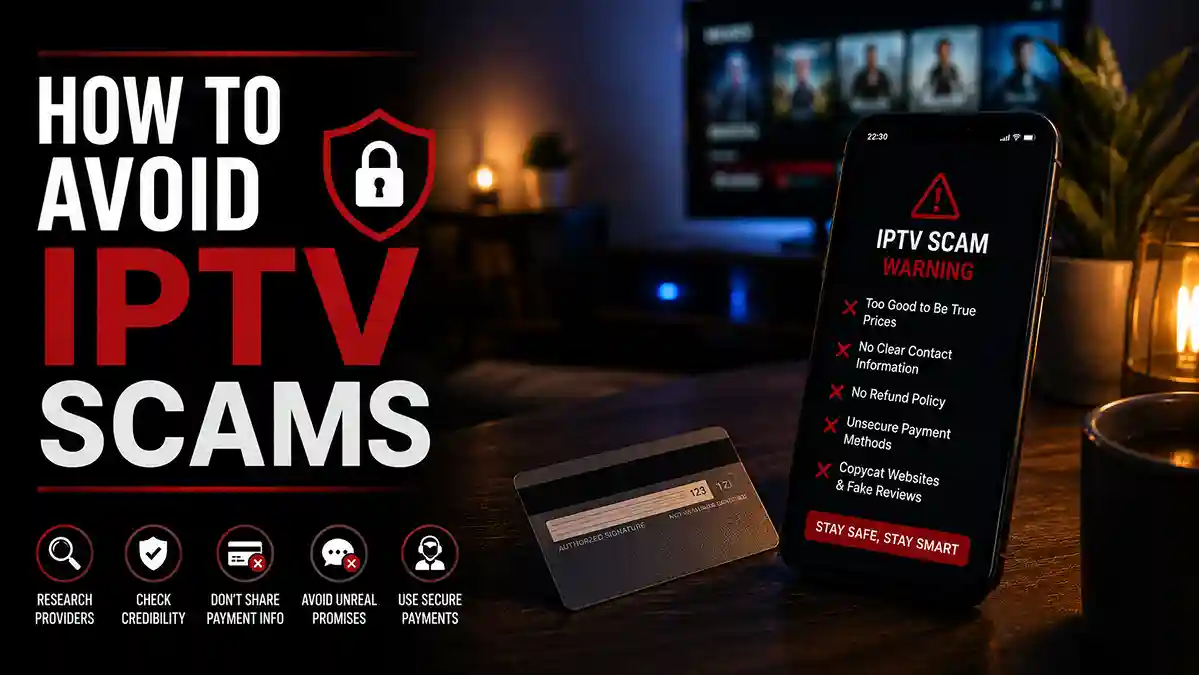
How to Avoid IPTV Scams: The Seven Tricks We See Most
Most advice on how to avoid IPTV scams is written by people who have never had to answer the message that comes afterwards. We have. It usually arrives two or three days after the payment, and it always starts the same way: I paid, nothing came, is this you?
It is never us. But the site they paid looked like us, because it was built from ours. So instead of a general warning, here is the actual shape of it: seven tricks, in the order we see them, and the one check that stops each.
If you only want the quick version of checking a site, that is on how to check a site before you pay. If you want the background on why this brand gets copied so often, that sits on our official website page.
The short version — Almost every case we hear about involves one of three things: a payment page that leaves the site, a message that arrived first, or a price too low to be real. Learning how to avoid IPTV scams is mostly learning to slow down at those three moments.
How we know this — Dozens of messages a month land in our inbox from people who paid somebody else. The list below is written from those messages, not from a general article about online fraud. Names and details stay private. The patterns do not.
On This page
What an IPTV Subscription Scam Actually Looks Like
Nobody gets caught by an obvious fake. An IPTV subscription scam in 2026 is a working website with a proper checkout, a chat widget in the corner and a page of reviews. The design is ours. The copy is often ours word for word. The only thing that has changed is the address at the top and the account the money goes into.
That is why judging by appearance fails. There is nothing to see. The difference is in where things point, not in how they look.
How to Avoid IPTV Scams: The Seven Tricks
Each one has a single check next to it. If you do nothing else, do those.
1. The address that reads almost right
A hyphen slipped in, a letter doubled, an ending you would not expect. Your eye reads the shape of the word, not the letters, and on a phone at night the shape is all you get.
The check: read the address out loud, one character at a time.
2. The payment page that leaves the site
You click to pay and the address bar changes to something unrelated, or the page suddenly asks for a bank transfer, a gift card or crypto. Those methods are chosen for one reason: once sent, they are gone.
The check: look at the address bar again before you type anything.
3. The message that arrived first
An offer lands in your messages from an account you have never dealt with, usually with a link and a discount attached. The link is the entire purpose of the message.
The check: if you did not start the conversation, do not follow the link.
4. The price that cannot work
Running servers costs money every month. A price far below everyone else is not a bargain, it is a sign the seller is not planning to be here in March. Ours sit on the pricing page and start at £24.99 for three months, and they stay there.
The check: if it is a third of the going rate, ask what happens in month two.
5. The countdown timer
Timers, stock counters and last three at this price exist to stop you leaving the page to think. Real services do not need you to decide in ninety seconds.
The check: close the tab. If the offer is still there tomorrow, it was never a deadline.
6. The support address that is not theirs
A shop selling subscriptions from a personal Gmail account has not paid for an email address, which tells you roughly how long the shop intends to exist.
The check: the support email should end in the same domain as the site.
7. The missing boring pages
Terms, refunds, an actual way to reach a person. Copies leave these out because they take work and nobody reads them, which is exactly what makes them useful. Ours are one click away, including the refund policy.
The check: open the footer. If the links are missing or lead nowhere, you have your answer.
Follow the Money, Not the Website
Clone sites are cheap to build and cost almost nothing to run, because there is no service behind them. The whole operation is a payment form wearing somebody else’s clothes. That is also the weak point: the site can be copied perfectly, but the payment cannot. It has to end up somewhere real.
So the question is never how does this site look. It is where does this money go, and who answers if it goes wrong. On a card payment you have some protection and a route back through your provider, and Which? sets out your consumer rights in plain terms. On a transfer or a gift card you have neither.
The Warning Signs, Side by Side
| Moment | Fine | Walk away |
|---|---|---|
| The address | Reads correctly letter by letter | Hyphen, extra letter, odd ending |
| The checkout | Card, same domain | Transfer, gift card, crypto only |
| First contact | You went to them | They messaged you |
| The price | Published and steady | A third of everyone else |
| The pressure | None | Timer, last few left |
| Support | Address on the site domain | Personal email or none |
| The footer | Terms, refunds, contact | Empty or dead links |
Resellers Are Not the Problem
This needs saying, because the two get mixed up constantly. Plenty of people sell this service who are not us, and most of them are straightforward, answer their messages and do a proper job. Buying through one is not a mistake and we have no argument with it.
Fake IPTV sellers are a different thing entirely. They are not reselling anything, because there is nothing behind the page. The line is simple: a reseller sells you access to a service that exists. A copy sells you a receipt. If you want the accounts created directly on our own servers, that happens here, and who we are is on its own page.
If It Already Happened
Deal with the money first, while the payment is recent. Contact your bank or card provider, keep the receipt, the address and every message. Do that before anything else, because it is the only part with a time limit on it.
After that, send us the address. We cannot recover your money and we will not pretend otherwise, but we do keep a note of what is circulating so the next person searching finds a warning instead of a checkout. If you want to be careful online generally, Get Safe Online covers the wider ground.
Frequently Asked Questions
What is the single best way to avoid IPTV scams?
Pay by card, on the site you typed in yourself, after reading the address one character at a time. That combination removes most of the risk in about twenty seconds.
The site looked identical to yours. How is that allowed?
It is not allowed, it is just easy. A page can be copied in an afternoon by anyone with a browser. Looking identical is the cheapest part of the whole operation.
Someone offered me a much cheaper deal on a messaging app. Should I take it?
Not if they contacted you first. We answer questions on WhatsApp all day, but we never message people who have not asked, and we never send payment links out of the blue.
Can I test the service before spending anything?
Yes. The 24-hour trial exists for exactly that, and it runs through WhatsApp so there is no card involved at all.
Where to Go Next
Once you know the shape of it, the rest is quick. The one-minute check is the short version, what changed in 2026 covers the newer patterns, and the common questions page answers most of what is left. If you would rather just look at the service, start here.
Bookmark one address, pay by card, and how to avoid IPTV scams stops being something you have to think about.